


Table of Contents
- The Monthly Close Cycle That Never Gets Faster
- What the Manual Gap Actually Costs You
- Why Connecting an AI Directly to NetSuite Is Not Enough
- The BigQuery Backbone: Speed Without Cluttering Your ERP
- What AI-Driven P&L Analysis Actually Looks Like
- From Static Reports to Actionable Intelligence
- Your AI, Your Way: Platform-Agnostic by Design
- Frequently Asked Questions
- How GURUS Solutions Can Help
Request More Info About AI-Driven P&L Analysis for NetSuite
The Monthly Close Cycle That Never Gets Faster
Every finance leader running NetSuite knows this rhythm. The period closes. Someone runs the Comparative Income Statement. The numbers land in Excel. Then the real work begins.
Your controller spends a morning pivoting the spreadsheet to isolate a revenue variance. Your FP&A analyst digs through sub-ledgers to trace a COGS spike to specific transactions. Someone else is manually cross-referencing discount codes against a promotional calendar to figure out why gross margin compressed 40 basis points. By the time the board deck is ready, a week has passed and the insights are already stale.
NetSuite captures every invoice, every journal entry, every expense with meticulous detail. The data is there. The problem is not the data. The problem is the gap between seeing a number and understanding its cause.
That gap is where your finance team lives for the first five to seven business days of every month. And no matter how experienced they are, the gap never shrinks. It just shifts to the next variance, the next period, the next board question nobody anticipated.
AI4NetSuite was built to close that gap permanently.
For the complete AI landscape: The 2026 Guide to AI in NetSuite: From NetSuite Next to AI4NetSuite, What's Real and What to Do Now
What the Manual Gap Actually Costs You
The manual P&L analysis cycle is not just slow. It is expensive in ways most organizations have never quantified.
Direct labor cost.
If your controller, FP&A analyst, and accounting manager collectively spend 40 hours per month on variance analysis, reconciliation, and board prep, and their blended fully loaded cost is $85 per hour, that is $3,400 per month, over $40,000 per year, spent preparing explanations for numbers that AI can analyze in seconds.
Decision latency.
The board meeting happens on the 15th. Your team finishes the analysis on the 12th. That means leadership is making decisions based on data that is already two weeks old by the time they see it. In a volatile quarter, two weeks of decision latency can mean the difference between catching a margin problem early and discovering it after it has compounded for another full period.
Opportunity cost.
Every hour your finance team spends pivoting spreadsheets is an hour they are not spending on forward-looking analysis, scenario modeling, or strategic planning. You hired experienced finance professionals to think strategically. The manual close cycle turns them into data preparers.
Error accumulation.
Manual analysis in Excel introduces human error at every step. A mislinked formula, a missed filter, a subtotal that includes the wrong date range. These errors do not always get caught, and when they reach the board deck, they erode confidence in the numbers. One bad data point in a board presentation takes months of credibility to recover from.
As Neil Stolovitsky, Director of products and Solutions at GURUS Solutions, frames it:
"The goal for every NetSuite customer is to spend less time as Data Preparers and more time as Strategic Advisors."
Why Connecting an AI Directly to NetSuite Is Not Enough
The obvious question is: why not just connect an AI agent directly to NetSuite via MCP and start asking questions?
You can. And for simple queries, it works. But for the kind of analysis that replaces a week of manual close work, a direct connection hits hard limits fast.
Performance.
Running a complex, multi-year year-over-year comparison across dozens of subsidiaries directly against your NetSuite instance means competing with every other process running in the environment. Long queries create performance lag. Governance limits constrain how much data you can process. Your finance team's analytical workload should not degrade the ERP experience for every other user in the system.
Siloed view.
A direct MCP connection to NetSuite only sees NetSuite data. But the most important P&L variances often trace back to causes that live outside the ERP. A spike in shipping costs lives in your 3PL system. A shift in ad-spend efficiency lives in your marketing platform. A change in customer acquisition cost lives in your CRM. If your AI can only see one system, it can identify the variance but it cannot explain the cause.
No pre-built financial logic.
NetSuite stores transactions. It does not store a ready-made P&L view that an AI can query intelligently. Anyone who has tried to rebuild a Profit and Loss statement from raw NetSuite data knows the pain: account reclassification, consolidation logic, intercompany eliminations, multi-currency translation.
As Neil Stolovitsky, Director of Products at GURUS, puts it bluntly:
"Good luck rebuilding your P&L and Balance Sheet with our competition, unless you want to reclassify millions of lines one by one to put them in the right account."
AI4NetSuite solves all three problems with a single architectural decision: the BigQuery backbone.
The BigQuery Backbone: Speed Without Cluttering Your ERP
AI4NetSuite synchronizes your NetSuite data into Google BigQuery. This is not a workaround. It is a deliberate architectural choice that delivers three things a direct connection cannot.
Sub-second analysis.
Run complex, multi-year year-over-year comparisons across dozens of subsidiaries without the spinning wheel or performance lag. The analytical workload happens in BigQuery, not in your ERP. Your NetSuite instance stays fast. Your finance team gets answers instantly.
A clean ERP.
Heavy analytical customizations inside NetSuite create technical debt that compounds over time. Every custom saved search, every scripted report, every scheduled export adds complexity that your admin team has to maintain. AI4NetSuite keeps your core system lean while moving analytical complexity to the cloud where it belongs.
Multi-source context.
Because BigQuery is a data warehouse, not just a NetSuite mirror, it can hold data from every system that matters to your business. Your AI can explain a dip in P&L margin by referencing a spike in shipping costs from your logistics provider or a shift in ad-spend efficiency from your marketing platforms. The analysis is not limited to what NetSuite can see.
Native Vector Search.
AI4NetSuite is built on Google BigQuery, which is the only major data warehouse platform that seamlessly integrates Vector Search into its infrastructure. This means the AI does not just match exact account codes or transaction descriptions.
It understands semantic relationships across your data, surfacing relevant transactions even when the language varies. Other platforms, including Oracle's, offer Vector Search capabilities but require additional configuration to activate. On BigQuery, it is built in.
And underneath all of this sits the GURUS AI Data Model: 20 years and 2,500 projects worth of NetSuite relationship mapping translated into pre-built views for P&L, Balance Sheet, transaction linking, inventory, and entity resolution.
Neil Stolovitsky, Director of Products at GURUS, describes it:
"The GURUS AI Data Model is a collection of tables and views created to represent your NetSuite Data within the data warehouse. We provide a P&L, a Balance Sheet and so many more views to avoid the manual work you'd need to do otherwise."
That data model is why AI4NetSuite can deliver intelligent P&L analysis out of the box. The financial logic is already built. The account classifications are already mapped. The consolidation rules are already applied. Your AI is not guessing at how to structure a Profit and Loss statement. It is querying one that has been built by people who have been doing this for two decades.
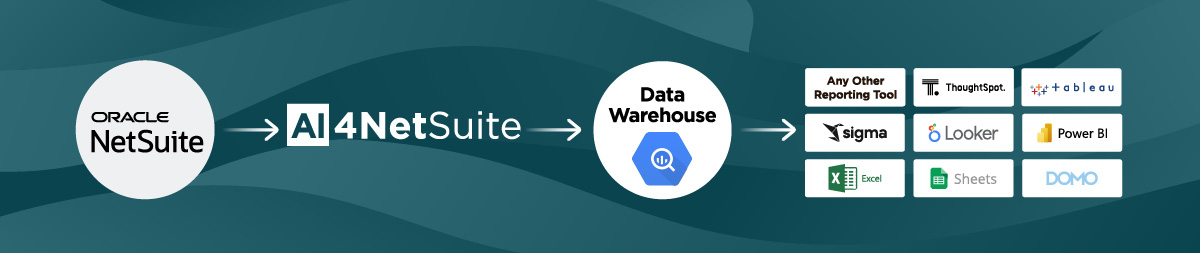
Caption: The GURUS AI Data Model
What AI-Driven P&L Analysis Actually Looks Like
This is not a concept. This is a real output from AI4NetSuite.
A finance leader opens their AI agent and enters a single prompt:
"Analyze the P&L for July 2025. Compare it to June and July of last year in 2024. Flag any line items with a variance greater than 15% and summarize the top 3 drivers for each based on the underlying transaction descriptions."

Caption: AI for NetSuite P&L analysis: a single prompt replaces hours of manual variance analysis with a narrative briefing sourced from live NetSuite data.
Within minutes, the AI agent, in this case Claude, queries the BigQuery-hosted NetSuite data and returns a narrative briefing:
Here's the full picture from your live NetSuite data. Let me walk you through what stands out.

Caption: The headline: July 2025 net income of approximately $404K is solid, up 25.9% year over year, but down 11.2% from June, with two distinct drivers pulling in opposite directions.
The 3 biggest drivers of the month-over-month net income decline:
- Sales Discounts (4520): This jumped from negative $425 in June to negative $59,575 in July, a 13,924% increase. The data shows a large-scale promotional campaign with 1,300+ transactions each carrying $25 discounts. The ROI question: Does the $531K year-over-year revenue lift justify this $59K investment?
- Gross Profit Compression: Cost of Sales grew 31.8% year over year, slightly outpacing revenue growth of 30.9%. Margin is down to 30.5% from 30.9% in June, reflecting underlying cost pressure.
- OpEx Step-downs (The Good News): Most OpEx lines improved. Training down 36.4%, Professional Services down 49.8%. Notably, a $2K Legal Fee reversal (JE50) resolved a property damage claim without payment."

That analysis just replaced a morning of spreadsheet work. And it did not just identify variances. It traced them to specific transaction-level causes, calculated the ROI implications, and flagged the good news alongside the bad.
From Static Reports to Actionable Intelligence
The P&L narrative is valuable on its own. But what makes it transformative is what comes next: the action items.
Instead of a static PDF that leadership has to interpret, AI4NetSuite delivers executive-ready next steps:
Validate Discounts (4520).
Confirm the July promotional campaign was intentional at this scale. If this continues into August, it requires a formal budget line. The 1,300+ transactions at $25 each suggest this was systematic, not one-off. Finance should confirm with the commercial team.
Investigate Other Expense (8000).
A new $750 charge appeared without a memo. Recommend reclassifying this before the month-end close. The AI flagged it not because the amount is material, but because it is anomalous. No transaction in this account carried a zero memo in the prior 12 months.
Monitor COGS Creep.
With year-over-year COGS growth outpacing revenue growth by 90 basis points, a margin review is recommended heading into Q3. The AI identified the pattern across four months of data, not just the current period.
This is the difference between reporting and intelligence. A report tells you what happened. Intelligence tells you what to do about it and why it matters.
Your CFO walks into the board meeting with a narrative that explains the quarter, specific action items that are already in motion, and a margin trend analysis that informs the Q3 forecast. No spreadsheet handoffs. No "let me get back to you on that." No stale data.
Your AI, Your Way: Platform-Agnostic by Design
AI4NetSuite is not locked to a single AI provider. It is platform-agnostic by design, supporting a variety of MCP-enabled AI agents so you can choose the model that fits your security and operational requirements.
The examples in this article use Claude, which is the LLM GURUS uses in product demonstrations for its strong analytical reasoning. But the same analysis works with ChatGPT, Gemini, or other specialized models. The intelligence comes from the data architecture, the GURUS AI Data Model, and the BigQuery backbone, not from any single AI provider.
As Neil explains:
"These agents don't just 'look' at a spreadsheet; they 'talk' to your BigQuery-hosted NetSuite data to find the story behind the numbers."
This matters for organizations with specific security, compliance, or vendor requirements. You are not making a permanent AI platform bet. You are investing in a data architecture that works with whatever AI agent you choose today and whatever better option emerges tomorrow.
For a detailed comparison of AI agents for NetSuite work: Claude vs ChatGPT vs Gemini for NetSuite Users
For the full AI tool landscape: Best AI Tools for NetSuite in 2026: A Complete Guide
How GURUS Solutions Can Help
GURUS Solutions has spent 20 years inside the monthly close cycle with NetSuite customers. We know exactly where the manual gaps live because we have watched finance teams work through them across 2,500 projects. AI4NetSuite was built from that experience, not from a product roadmap.
The P&L analysis capability is not a bolt-on feature. It is a direct expression of the GURUS AI Data Model, the pre-built financial views, the BigQuery backbone, and the platform-agnostic AI architecture that together replace the export-to-Excel cycle permanently.
Your finance team deserves to spend their expertise on strategy, not spreadsheets. The numbers are already in NetSuite. The analysis should be instant.
Ready to see your P&L analyzed by AI?
AI4NetSuite Level 3 in action: cross-platform customer analysis joining NetSuite revenue data with Zendesk support data to surface retention risk and true profitability.
See the full platform: forecasting, anomaly detection, dashboards, and the BigQuery data warehouse pipeline.
Request a Free AI4NetSuite Demo
Learn how conversational AI inside NetSuite accelerates your Level 2 capabilities.
Download the AI Chatbot Data Sheet
This guide is part of the GURUS NetSuite AI Guides and Playbooks, practical playbooks for executives, admins, business users, and partners. New guides published weekly.
Talk to an AI Specialist
FAQ
How is this different from NetSuite's standard Comparative Income Statement?
NetSuite's Comparative Income Statement shows you the numbers. AI4NetSuite tells you why the numbers changed and what to do about it. The standard report requires your team to export to Excel and manually trace variances to underlying transactions. AI4NetSuite performs that analysis instantly, returning a narrative briefing with specific drivers, transaction-level detail, and recommended actions.
Does this work with our custom chart of accounts?
Yes. The GURUS AI Data Model maps your specific chart of accounts, custom segments, departments, classes, and locations into pre-built BigQuery views. The P&L and Balance Sheet structures reflect your organization's actual reporting hierarchy, not a generic template. The model has been refined across 2,500 NetSuite implementations.
How current is the data?
AI4NetSuite synchronizes your NetSuite data to BigQuery on a schedule configured for your needs. For most finance teams, this means the data is current as of the prior business day or more frequently depending on your requirements. The AI is always querying the latest synchronized data, not a cached report.
Can the AI analyze data from outside NetSuite alongside the P&L?
Yes. This is a core architectural advantage. Because AI4NetSuite runs on BigQuery, it can join NetSuite financial data with data from your CRM, logistics providers, marketing platforms, HR systems, or any other source. A P&L variance caused by a shipping cost increase from your 3PL can be traced to its source in a single query, even though the cause lives outside NetSuite.
What if we have dozens of subsidiaries with different currencies?
The GURUS AI Data Model was built for OneWorld environments. Multi-currency translation, intercompany eliminations, and subsidiary consolidation logic are pre-built into the data model. The AI handles consolidated and subsidiary-level analysis natively.
Can we customize which variances the AI flags?
Yes. The variance threshold (the 15% used in the example) is set by the user in the prompt. You can ask for 5%, 10%, 25%, or any threshold that matches your materiality standards. You can also ask the AI to focus on specific line items, specific subsidiaries, specific time periods, or specific comparison bases.
Does this replace our finance team?
No. It replaces the manual, repetitive work that prevents your finance team from doing what you hired them to do. The AI handles data preparation, variance identification, and initial driver analysis. Your team handles judgment, context, and strategic interpretation. Neil Stolovitsky, Director of Products and Solutions at GURUS, frames it: "You're not replacing your CFO; you're augmenting them. It's like giving your most critical thinkers a dedicated data scientist who can answer their questions in seconds."
How fast can we get this running?
AI4NetSuite installs within your existing NetSuite environment and synchronizes to BigQuery without disrupting your ERP. The GURUS AI Data Model includes pre-built P&L and Balance Sheet views. Most organizations are running AI-driven P&L analysis within weeks of deployment, not months.