


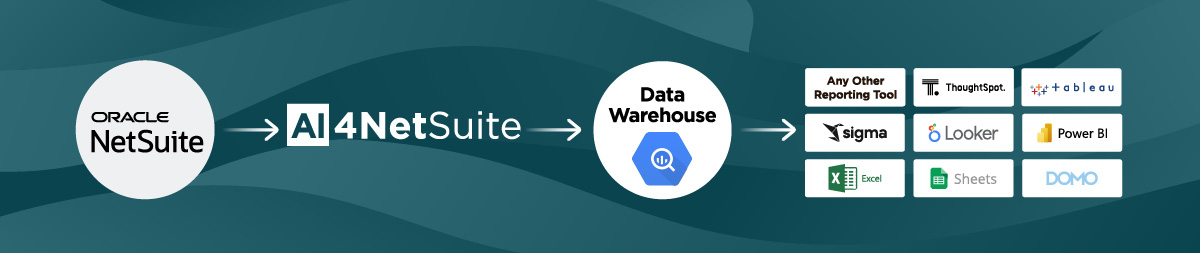
There are two ways to connect Claude to NetSuite: a direct integration through NetSuite's MCP server, custom RESTlets, or middleware, or a data warehouse architecture that syncs NetSuite data into an analytics environment first. Direct integration is simplest for real-time operational lookups, but it hits SuiteCloud governance limits and can slow your ERP on complex analytical queries. AI4NetSuite uses the data warehouse pattern, syncing NetSuite into Google BigQuery so Claude can run multi-year financial analysis in sub-seconds with zero impact on ERP performance, role-based access enforced at the data layer, and a dual-engine design that prevents AI math errors.
Table of Contents
- The Real Question When Connecting Claude to NetSuite
- What a Direct NetSuite Connection Actually Costs at Scale
- Why a Direct Claude-to-NetSuite Connection Is Not Enough
- The Data Warehouse Architecture Behind AI4NetSuite
- Connecting Claude to NetSuite in Practice: Four Technical Pathways
- From Raw Access to Governed Intelligence
- Choosing the Right NetSuite AI Architecture for Your Organization
- How GURUS Solutions Can Help
- Frequently Asked Questions
Request More Info About Connecting Claude to NetSuite
The Real Question When Connecting Claude to NetSuite
Anthropic's Claude models keep raising the bar for complex enterprise reasoning, financial modeling, and natural language querying. So it is no surprise that finance, operations, and IT leaders running NetSuite are asking the same question: what is the best way to point conversational AI at our operational data?
The debate almost always comes down to two architectures. You can build a direct connection, wiring Claude straight into NetSuite through its native Model Context Protocol server, custom RESTlets, or a middleware layer. Or you can route through a dedicated data warehouse solution like AI4NetSuite, which continuously syncs your NetSuite data into an analytics-optimized environment first.
Both patterns are legitimate. Both have real use cases. The right answer depends on your query volume, your data size, your reporting complexity, and your tolerance for risk. What follows is a practical evaluation of each approach, the three pillars every enterprise leader has to address before rollout, and a clear framework for choosing.
For the complete AI landscape, start here: The 2026 Guide to AI in NetSuite: From NetSuite Next to AI4NetSuite, What's Real and What to Do Now.
What a Direct NetSuite Connection Actually Costs at Scale
NetSuite is built on an OLTP framework, an online transaction processing engine optimized for fast, reliable single-transaction commits: approving a sales order, generating a fulfillment, posting a vendor bill. That design is excellent for running a business. It is not designed for the sprawling analytical queries an LLM generates when it reasons across multiple record types, historical periods, and custom fields.
When you connect Claude directly to that OLTP engine, the costs show up in four places.
Governance and timeout limits.
A complex multi-year analytical join can burn through SuiteCloud governance units or trip an HTTP gateway timeout in the middle of a live conversational session. The query that would answer your CFO's question never returns.
ERP system impact.
Heavy LLM analytical queries consume the same operational concurrency slots your daily users rely on. Push enough AI traffic through the live instance and you risk slowing core ERP response times for everyone posting transactions.
Context window and schema overhead.
Feeding raw NetSuite SuiteQL schemas into Claude eats significant tokens before the model even starts reasoning. That raises cost per query and stretches response times.
Dynamic security complexity.
Wrapping every session in the right role-based permissions is hard to maintain seamlessly across complex multi-subsidiary structures, and getting it wrong is a compliance problem, not a performance one.
None of this makes a direct connection wrong. It makes it a tool with a ceiling, and it is worth knowing exactly where that ceiling sits before you build against it.
Why a Direct Claude-to-NetSuite Connection Is Not Enough
For simple operational lookups, a direct connection to NetSuite works well. Ask "what is the status of Purchase Order #10492," and a native MCP call answers cleanly. The limits appear when you move from lookups to the kind of analysis that actually replaces manual reporting work.
It only sees NetSuite.
A direct connection sees NetSuite data and nothing else. But many of the most important questions trace to causes that live in other systems. Support strain sits in Zendesk. Pipeline shifts sit in your CRM. Shipping cost spikes sit in your 3PL. If the AI can only see one system, it can report a number but cannot explain the cause.
There is no pre-built financial logic to query.
NetSuite stores transactions. It does not hand you a ready-made P&L or Balance Sheet view that an AI can query intelligently. Anyone who has tried to rebuild those statements from raw tables knows the work involved: account reclassification, consolidation, intercompany eliminations, multi-currency translation.
As Neil Stolovitsky, Director of Products and Solutions at GURUS Solutions, puts it: "Good luck rebuilding your P&L and Balance Sheet with our competition, unless you want to reclassify millions of lines one by one to put them in the right account."
Raw access is not governed access.
A direct pipe passes whatever the query returns. Enforcing that a user who cannot see subsidiary financials in NetSuite also cannot see them through Claude takes deliberate engineering, not a polite instruction in a prompt.
The Data Warehouse Architecture Behind AI4NetSuite
AI4NetSuite takes the second path. It continuously synchronizes your NetSuite operational data into Google BigQuery, structured specifically for LLM retrieval and semantic reasoning. This is a deliberate architectural choice, and it resolves the ceiling of a direct connection in four ways.
Sub-second analytical performance.
Queries run against pre-aggregated, flattened star schemas, so a multi-year trend across dozens of subsidiaries returns fast instead of timing out.
Zero impact on your ERP.
Analytical workloads are fully decoupled from NetSuite. Your operational governance units and concurrency stay reserved for the people running the business, and the AI never competes with them.
Multi-source context.
Because BigQuery is a warehouse and not just a NetSuite mirror, it holds data from every system that matters, from your CRM to your logistics provider to your marketing platforms. Claude can explain a margin dip by joining a NetSuite P&L variance to a shipping cost spike from your 3PL in a single query.
A schema Claude can actually read.
Curated dimensional models let Claude navigate financial data with higher semantic accuracy and far lower token consumption than raw SuiteQL. Underneath it sits the GURUS AI Data Model, mapping translated data into pre-built views for P&L, Balance Sheet, transaction linking, inventory, and entity resolution. The financial logic is already built, so the AI queries a statement rather than trying to assemble one.
As Neil sums up the positioning: "NetSuite is just the start; GURUS AI is the ultimate destination for true enterprise intelligence."
Connecting Claude to NetSuite in Practice: Four Technical Pathways
When GURUS Solutions plans a NetSuite AI integration, we evaluate four primary pathways against your operational goals.
NetSuite native MCP server.
Best for standardized, low-complexity operational queries. NetSuite's native MCP implementation gives Claude a clean, standard interface to query records. It shines for transactional lookups and can struggle with heavy aggregation over large historical datasets.
Custom SuiteScript RESTlets.
Best for highly specialized, single-purpose workflow actions. RESTlets give developers total control over inputs and outputs, but building them for broad, open-ended conversational analytics tends to create maintenance load and technical debt over time.
Middleware platforms (Celigo, Boomi).
Best for cross-system transactional synchronization. These iPaaS tools excel at pushing transactional events between cloud apps. As a transport layer they are useful, but middleware alone does not provide the semantic indexing or star-schema modeling that deep financial analysis needs.
Data warehouse solution (AI4NetSuite).
Best for executive reporting, trend analysis, and broad conversational intelligence. Flattening NetSuite data into an analytics-ready warehouse gives Claude optimal context for multi-dimensional reporting without touching core ERP operational speed.
The core decision usually lands between the first pathway and the last. Here is the tradeoff at a glance.
| Consideration | Direct Connection | Data Warehouse (AI4NetSuite) |
|---|---|---|
| Best for | Real-time operational lookups | Executive reporting and trend analysis |
| Query performance at scale | Governance and timeout risk | Sub-second on flattened schemas |
| Impact on ERP performance | Consumes live concurrency | Fully decoupled, zero impact |
| Data freshness | Instant, zero sync latency | Near-real-time, brief sync window |
| Multi-source context | NetSuite only | NetSuite plus any connected source |
| Financial guardrails | Prompt-level only | Built-in KPI views and verification |
The warehouse pattern is what makes analytical prompts practical. A finance leader can ask Claude to "show total revenue by subsidiary for the last three fiscal years, flag any subsidiary where gross margin moved more than 5% year over year, and list the top transactions driving each shift," and get a governed, narrative answer in seconds.
You will find more ready-to-use prompts in the NetSuite AI Prompt Library. For a full worked example of this pattern in a monthly close, see AI-Driven P&L Analysis for NetSuite.
Choosing the Right NetSuite AI Architecture for Your Organization
There is no single correct architecture, only the right fit for your profile. A useful way to decide is to weigh three variables.
Query volume and complexity.
If your team mostly needs quick transactional lookups, a direct connection may be all you need. If they need multi-year, multi-subsidiary, multi-source analysis, the warehouse pattern is the one that will not time out.
Impact tolerance.
If you cannot risk analytical traffic slowing your live ERP during month-end, decoupling the workload into a warehouse protects operational performance for everyone else.
Risk and compliance posture.
If your reporting touches regulated or restricted financial data, data-layer permission enforcement and verified computation are not nice-to-haves. They are the baseline for putting AI anywhere near the ledger.
For a broader view of the tools that pair with each architecture, see Best AI Tools for NetSuite in 2026: A Complete Guide.
How GURUS Solutions Can Help
Out-of-the-box tools provide data access. Successful enterprise deployment takes deep ERP expertise and deliberate safety engineering, and that is where 20 years and 2,500 projects of NetSuite work matters. GURUS Solutions configures the semantic layer that maps executive language like bookings, ARR, and gross margin by channel to your specific custom fields and chart of accounts. We transform native transaction tables into optimized schemas so Claude receives clean, contextual data.
Whether a targeted direct connection or a full data warehouse architecture is right for your business, the goal is the same: conversational AI you can trust against your live financials.
Contact GURUS Solutions today
Frequently Asked Questions
Can I just use NetSuite's native MCP server with Claude?
Yes, and for standardized operational lookups it works well. The native MCP server gives Claude a clean interface to query records in real time. The limits appear with complex aggregation over large historical datasets, where governance units and timeouts become a factor. Many organizations use the native connection for lookups and a warehouse for analysis.
Does routing through a data warehouse mean my data is stale?
No. AI4NetSuite syncs on continuous schedules, from hourly to near-real-time incremental updates depending on your needs. Brand-new entries may sit in a brief sync window, but for the multi-year and month-over-month analysis the warehouse is built for, that window is immaterial.
How does the warehouse enforce my NetSuite permissions?
AI4NetSuite replicates NetSuite's role-based access control into dataset security policies and pre-filters every result to the logged-in user's permissions before any context reaches Claude. A user who cannot see a subsidiary's financials in NetSuite cannot see them through the AI either.
Will heavy AI queries slow down NetSuite for other users?
Not with the warehouse pattern. Analytical workloads run in BigQuery, fully decoupled from your ERP, so operational concurrency and governance units stay reserved for daily transactions. This is a primary reason to decouple rather than query the live instance directly.
Do I have to use Claude, or can I use another AI model?
You are not locked in. AI4NetSuite is platform-agnostic by design and works with MCP-enabled agents including Claude, ChatGPT, and Gemini. GURUS uses Claude in product demonstrations for its analytical reasoning, but the intelligence comes from the data architecture, not from any single model.