


Table of Contents
- The Month-End Close Has a Blind Spot
- How NetSuite GL Auditing Works Today (And Where It Fails)
- How AI4NetSuite Performs Journal Entry Auditing: The MCP and Data Model Architecture
- The Five Forensic Red Flags AI4NetSuite Scans For
- Real Audit Results: AI4NetSuite Flags 4 High-Risk Journal Entries in July 2025
- What Each Flagged Entry Revealed
- From Sample-Based Auditing to 100% NetSuite Ledger Coverage
- Frequently Asked Questions
- How GURUS Solutions Can Help
Request More Info About AI Journal Entry Audit for NetSuite
AI4NetSuite, powered by GURUS Solutions, enables AI-driven journal entry auditing for NetSuite by synchronizing GL data into Google BigQuery and querying it through MCP-enabled AI agents like Claude. A single natural-language prompt can scan every journal entry in a period against five forensic accounting red flags: after-hours posting, user anomalies, round-number thresholds, same-day duplicates, and dormant account activity. The AI scores each entry additively and ranks them by risk severity. In a July 2025 audit, the platform flagged a $165,000 entry with a 4-out-of-5 risk score: posted on a Saturday evening by a user with no history on that account, to a Deferred Revenue account with zero prior journal activity in two years.
The Month-End Close Has a Blind Spot
Controllers, compliance teams, and internal auditors face the same pressure every period: verify the integrity of the General Ledger without bottlenecking the close.
The ledger might contain thousands of journal entries per month. Among them, a handful may be erroneous, unauthorized, or deliberately manipulated. Finding those entries through manual sampling is a statistical gamble. Building rigid scripts to flag them generates more false positives than actual insights. Hiring external auditors to review everything is expensive and retrospective, catching problems weeks after the books are locked.
AI4NetSuite eliminates that blind spot. Using an MCP connection to a governed BigQuery data warehouse, the AI scans every journal entry in the period against five forensic accounting red flags, scores them by risk, and delivers a prioritized audit dashboard before the close, not after.
For the complete AI landscape: The 2026 Guide to AI in NetSuite: From NetSuite Next to AI4NetSuite, What's Real and What to Do Now
How NetSuite GL Auditing Works Today (And Where It Fails)
Most internal audit processes in NetSuite environments rely on some combination of three approaches, each with significant limitations.
Manual sampling.
An auditor pulls a random sample of journal entries, typically 10 to 20 percent of the total, and reviews them individually for irregularities. The problem is statistical: if the fraudulent or erroneous entry falls outside the sample, it goes undetected. A 10 percent sample means a 90 percent chance of missing any given entry.
Deterministic scripts.
Custom saved searches or SuiteScript reports flag entries matching predefined rules, such as amounts above a threshold or entries posted on weekends. These catch the obvious cases but generate high volumes of false positives because they apply rigid criteria without context. A scheduled batch entry that runs every Saturday evening at 8 PM is flagged the same as an unauthorized manual posting at the same time. The auditor spends more time dismissing false flags than investigating real risks.
Post-close external review.
External auditors review the ledger after the period is finalized. They bring expertise but they bring it late. Findings arrive weeks or months after the entries were posted. Corrections become restatements. Restatements become board conversations. Board conversations become credibility problems.
All three approaches share a fundamental weakness: they look at individual entries in isolation, without historical context about user behavior, account activity patterns, or cross-entry correlations. A $165,000 entry to Deferred Revenue looks unremarkable by itself. It becomes a critical flag only when you know that the posting user has never touched that account, the amount is a perfectly round number, it was posted on a Saturday, the account had zero journal activity in the prior two years, and the same amount appears twice on the same day.
Catching that pattern requires analyzing every entry against every dimension simultaneously. Manual sampling cannot do this. Deterministic scripts address one dimension at a time. Post-close review does it too late.
How AI4NetSuite Performs Journal Entry Auditing: The MCP and Data Model Architecture
AI4NetSuite takes a different approach. Your NetSuite GL data syncs into Google BigQuery through the GURUS AI Data Model, which maps every transactional relationship, user metadata field, account hierarchy, and posting timestamp into a clean, queryable structure.
The AI Data Model goes beyond replicating the raw tables. It indexes historical patterns to create behavioral baselines:
- Historical user posting habits: which users typically post to which GL accounts, and how frequently.
- Transaction frequency per account: how often each account receives journal entries in a normal period, establishing dormancy thresholds.
- Time-of-day baselines: when entries are typically posted for each account and user, distinguishing normal batch processing windows from anomalous after-hours activity.
This indexed historical layer is what transforms raw NetSuite data into an auditable intelligence matrix. When the AI scans a current-period journal entry, it is not evaluating the entry in isolation. It is comparing it against months of established behavioral patterns to determine whether the entry is consistent with how the ledger normally operates.
Because the entire analysis runs in BigQuery, the production NetSuite instance is completely unaffected. Audit workloads do not compete with transactional processing.
The Five Forensic Red Flags AI4NetSuite Scans For
The AI evaluates every journal entry in the period against five classic forensic accounting red flags. Each flag triggered adds one point to the entry's composite risk score, with a maximum score of 5.
After-hours activity.
Entries posted late at night, on weekends, or outside the organization's normal business hours. Legitimate batch processes sometimes run off-hours, but manual postings during these windows warrant scrutiny.
User anomalies.
A user posting to a GL account they have historically never touched. The AI builds this baseline from months of posting history per user per account. A first-time posting to a sensitive account like Deferred Revenue or Accrued Liabilities triggers this flag regardless of the user's seniority.
Round-number thresholds.
Large, perfectly round amounts above $1,000. Natural accounting distributions follow predictable digit patterns (Benford's Law). Perfectly round numbers at high dollar values are statistically anomalous and warrant review.
Same-day duplicates.
Identical amounts hitting the ledger on the same day. Duplicate entries can indicate processing errors, intentional double-posting, or kiting schemes.
Dormant account activity.
Entries posted to accounts that have rarely or never received journal activity in prior periods. A GL account with zero postings in two years suddenly receiving a $165,000 entry is a significant anomaly regardless of who posted it.
The additive scoring model means an entry triggering one flag receives routine review, while an entry triggering four or five flags receives immediate escalation. The AI handles the prioritization so auditors spend their time on the entries that matter most.
Real Audit Results: AI4NetSuite Flags 4 High-Risk Journal Entries in July 2025
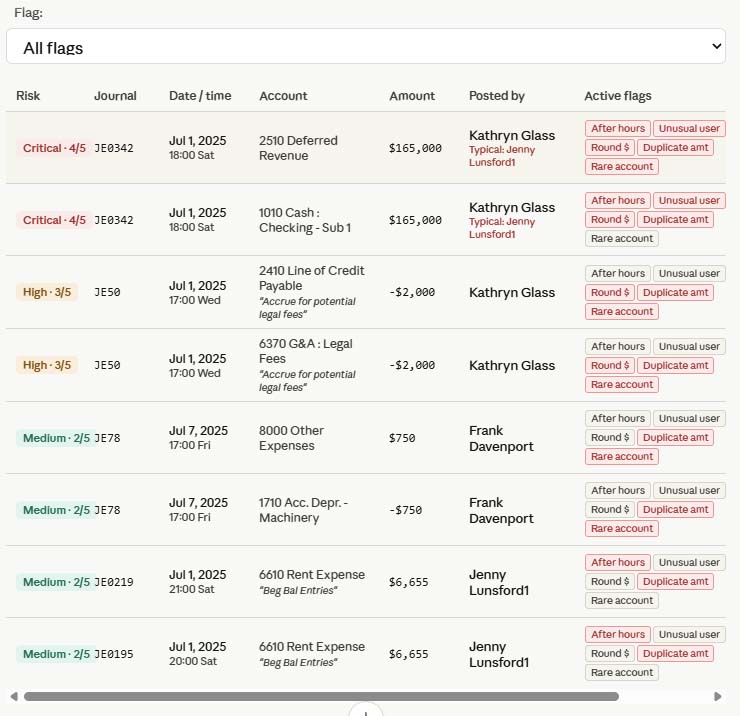
In a test run on July 2025 data, AI4NetSuite scanned the full ledger and surfaced 4 unique journal IDs triggering at least one risk flag, producing 8 flagged line items. The AI categorized them by risk severity.
For more AI prompt examples across finance, operations, and sales: NetSuite AI Prompt Library
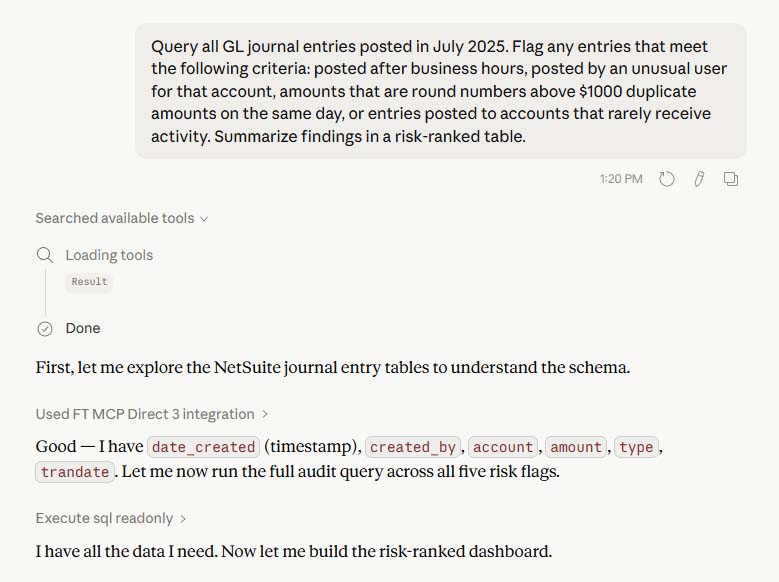
The forensic prompt used:
"Query all GL journal entries posted in July 2025. Flag any entries that meet the following criteria: posted after business hours, posted by an unusual user for that account, amounts that are round numbers above $1,000, duplicate amounts on the same day, or entries posted to accounts that rarely receive activity. Summarize findings in a risk-ranked table."
Results:
| Journal ID | Risk Score | Key Triggers | Primary Suspect Field | Risk Status |
|---|---|---|---|---|
| JE0342 | 4 / 5 | After-Hours, User Anomaly, Round Number, Dormant Account | $165,000 | Critical |
| JE50 | 3 / 5 | Round Number, Same-Day Duplicate, Dormant Accounts | $2,000 | High |
| JE78 | 2 / 5 | Same-Day Duplicate, Dormant Accounts | $750 | Medium |
| JE0195 / 0219 | 2 / 5 | After-Hours, Same-Day Duplicate | $6,655 | Medium |
What Each Flagged Entry Revealed
JE0342: The $165,000 Saturday Night Entry (Critical, 4/5)
A $165,000 debit to account 2510 Deferred Revenue, posted at 6:00 PM on a Saturday by user Kathryn Glass.
The AI Data Model revealed four independent anomalies on this single entry. First, Jenny Lunsford is the exclusive historical poster for this account; Kathryn Glass has never posted to it before. Second, the $165,000 amount is perfectly round. Third, the same amount appears twice on July 1st as a duplicate pair. Fourth, the Deferred Revenue account had zero historical journal postings in the prior two years.
Four independent flags on one entry. Potential unauthorized revenue manipulation or material error. This warrants immediate forensic isolation and escalation before the period closes.
JE50: The $2,000 Legal Accrual (High, 3/5)
A $2,000 accrual entry for "potential legal fees in property damage deposit claim" posted to 2410 Line of Credit Payable and 6370 Legal Fees.
The posting user (Kathryn Glass) is the typical user for these accounts, so the user anomaly flag did not trigger. However, both accounts are highly dormant with only one historical posting each, the amount is round, and the $2,000 hits the ledger twice on the same day.
Likely a valid business transaction, but the AI correctly flagged it for manual documentation review to ensure the legal liability is properly substantiated. A legitimate entry that still deserves a second look.
JE78: The $750 Depreciation Adjustment (Medium, 2/5)
A $750 depreciation entry posted on a Friday afternoon to 8000 Other Expenses and 1710 Accumulated Depreciation.
Both accounts are rare recipients of journal activity, and the amount creates a same-day duplicate pair. Depreciation adjustments are programmatic and routine. Low concern, but the AI surfaced it because the account dormancy dimension triggered. A quick verification confirms the entry and clears the flag.
JE0195 and JE0219: The Saturday Batch Entries (Medium, 2/5)
Two large batch entries posted on a Saturday evening between 8:00 PM and 9:00 PM, triggering the weekend timing flag and a duplicate $6,655 rent expense flag.
The AI noted a critical contextual detail: the memo field reads "Beg Bal Entries." Automated period-open system entries frequently run off-hours. This is a recognized business process that needs authorization confirmation, not investigation. The AI flagged it correctly on the dimensions but provided the context that allows the auditor to clear it in seconds.
From Sample-Based Auditing to 100% NetSuite Ledger Coverage
Traditional internal audit reviews a sample. AI4NetSuite reviews everything.
The shift from sample-based to 100% coverage changes the economics of internal audit. You no longer need to decide which entries to review and which to skip. You no longer accept the statistical risk that a material misstatement falls outside your sample. The AI scans the full population and surfaces the entries that deserve human attention.
The auditor's role does not diminish. It sharpens. Instead of spending hours pulling samples and reviewing unremarkable entries, the auditor spends their time on the four entries that actually warrant investigation. The AI handles coverage. The auditor handles judgment.
For organizations preparing for external audits, SOX compliance, or board-level financial reporting, 100% ledger coverage with a documented, repeatable methodology provides a defensible audit trail that sample-based approaches cannot match.
The same single-prompt approach powers AI-driven P&L variance analysis, inventory dead stock and overstock detection, vendor performance scorecards, and sales pipeline diagnostics, all running on the same BigQuery backbone and GURUS AI Data Model.
How GURUS Solutions Can Help
GURUS Solutions has spent 20 years inside NetSuite environments where finance teams close the books under pressure and hope nothing slipped through. AI4NetSuite was built to replace hope with certainty.
Your internal audit team deserves to review every journal entry in every period, scored against forensic dimensions and ranked by risk, before the books close. The GL data is already in NetSuite. The forensic intelligence should be instant.
Ready to see your ledger audited by AI?
Talk to an AI Specialist
Frequently Asked Questions
How is this different from NetSuite's Financial Exception Management?
NetSuite's Financial Exception Management uses AI to flag anomalous transactions and missing entries based on historical patterns. It is a strong native feature for identifying exceptions within the ERP. AI4NetSuite's forensic audit capability goes further by scoring entries across five simultaneous forensic dimensions, comparing against historical user-level and account-level behavioral baselines built in BigQuery, and providing contextual analysis (such as reading memo fields to distinguish batch processing from manual entries).
Can the AI read memo fields and supporting documentation?
Yes. The AI can analyze memo fields, descriptions, and any text stored in NetSuite transaction records. With Vector Search enabled on BigQuery, it can also scan unstructured documents such as email threads, approval records, and attached files to provide qualitative context alongside the quantitative flags.
Does this replace our external audit?
No. AI4NetSuite augments internal audit and pre-close review processes. External auditors bring independent judgment and regulatory authority that an internal tool does not replace. However, organizations that run AI4NetSuite's forensic sweep before external audit typically experience faster, smoother audit engagements because material issues have already been identified and addressed.
Can we customize the red flag criteria?
Yes. The five forensic dimensions (after-hours, user anomaly, round numbers, same-day duplicates, dormant accounts) are defined in the prompt. You can adjust thresholds, add additional dimensions, change scoring weights, or create different sweep profiles for different entity types. The AI adapts to whatever forensic methodology your organization follows.
How far back does the historical baseline extend?
The GURUS AI Data Model indexes as much historical data as you synchronize to BigQuery. Most organizations load 12 to 24 months of history to establish robust behavioral baselines. Longer history windows produce more accurate anomaly detection, particularly for dormant account flagging and user behavior profiling.
Will the auditors on our team need training to use this?
The interface is natural language. Auditors describe what they want to review in plain English, and the AI translates the request into the appropriate query. No SQL knowledge or BigQuery expertise is required. The forensic prompt shown in this article can be used as-is or customized to match your organization's specific audit procedures.