


AI4NetSuite, powered by GURUS Solutions, enables AI-driven month-end close readiness assessments for NetSuite by synchronizing GL, AP, AR, and intercompany data into Google BigQuery and querying it through MCP-enabled AI agents like Claude. A single prompt scores your close readiness out of 100, flags blocking items, and surfaces the specific unposted transactions, stale payables, prior-period open invoices, and missing accruals that will cause problems if the books close without them.
Table of Contents
- The Month-End Close Problem That Spreadsheet Checklists Cannot Solve
- Where Manual NetSuite Close Processes Break Down
- How AI4NetSuite Scores Your Month-End Close Readiness
- Real Results: AI Returns a 42/100 Close Readiness Score with Four Blockers
- The Prior-Period Check Your NetSuite Close Process Is Probably Skipping
- Running the AI Close Score Daily During Close Week
- How GURUS Solutions Can Help
- Frequently Asked Questions
Request More Info About AI Month-End Close for NetSuite
The Month-End Close Problem That Spreadsheet Checklists Cannot Solve
Every controller knows the feeling. Two days before the target close date. The team says everything is posted. A spot check reveals a stack of vendor bills sitting unposted since January. Someone forgot. They always do.
Month-end close is a coordination problem: a dozen open items scattered across two subsidiaries, three people's queues, and a NetSuite instance that does not volunteer the information you need unless you know exactly where to look.
Most accounting teams manage close with a spreadsheet or shared task list. Each item requires someone to manually run a saved search, read the result, and update the tracker. Some items get checked thoroughly. Others get skimmed. One or two fall through, often the same ones every month.
The structural problem is that manual checklists are only as good as the last time someone checked. An unposted bill from six months ago does not surface unless someone specifically searches for unposted bills. A prior-period invoice that was never collected does not flag itself. These items accumulate silently, and the first person to notice is usually the auditor.
AI4NetSuite replaces that manual process with a single prompt that runs every close check simultaneously, scores your readiness out of 100, and surfaces the specific blockers your team needs to resolve before the books lock. The same governed data layer that powers AI-driven P&L variance analysis provides the transactional foundation for the close readiness assessment, because every P&L anomaly traces back to a posting that either happened correctly or did not happen at all.
For the complete AI landscape: The 2026 Guide to AI in NetSuite: From NetSuite Next to AI4NetSuite, What's Real and What to Do Now
Where Manual NetSuite Close Processes Break Down
Manual close checklists fail in three predictable ways.
Items get skipped during busy weeks.
The checks that require the most effort, like searching for prior-period open transactions or auditing stale AP balances, are the first to get deferred when the team is under pressure. These are also the checks most likely to surface material issues.
The checklist only covers what someone thought to include.
An unposted bill from a vendor the team does not regularly work with will not appear on a checklist that was built around routine processes. The AI scans every transaction across every vendor, every account, and every period. It does not rely on someone anticipating the problem.
Status tracking lags behind reality.
A checklist item marked "done" at 9 AM may no longer be accurate by 3 PM if new transactions post during the day. The AI readiness score can be refreshed at any point during close week, reflecting the current state of the ledger rather than the state someone last checked.
How AI4NetSuite Scores Your Month-End Close Readiness
AI4NetSuite syncs your NetSuite GL, AP, AR, and intercompany data into BigQuery through the GURUS AI Data Model. The AI agent queries this warehouse against seven standard close criteria simultaneously:
Unposted vendor bills across all subsidiaries and periods. Unposted journal entries for the current period. Prior-period open invoices that remain uncollected. Stale unpaid AP bills beyond normal payment cycles. Intercompany transaction reconciliation status. Period-end accrual completeness. Elimination journal posting status.
Each criterion is scored and categorized as a blocker, a warning, or clean. The composite score out of 100 gives the controller a single number that answers "are we ready to close?" without running a single saved search. The same BigQuery architecture that enables AI-driven journal entry auditing with forensic scoring applies here: the AI evaluates every transaction against multiple dimensions simultaneously rather than checking one criterion at a time.
The entire assessment runs in BigQuery with zero impact on the production NetSuite instance.
Real Results: AI Returns a 42/100 Close Readiness Score with Four Blockers
This assessment was run against the GURUS demo NetSuite environment, two active subsidiaries, scored against seven close criteria. The dataset includes scenarios more extreme than a typical well-managed business would accumulate. Whether you have 5 unposted bills or 50, the system finds them all, and the consequences of missing them are the same in kind if not in scale.
The prompt:
"Run a month-end close readiness assessment for July 2025 across all subsidiaries. Check for unposted vendor bills, unposted journal entries, prior-period open invoices, stale unpaid AP, intercompany reconciliation status, and elimination journal completeness. Score overall readiness out of 100 and categorize each finding as a blocker, warning, or clean."
Overall readiness: 42 out of 100. Four blockers. Two warnings. One clean.
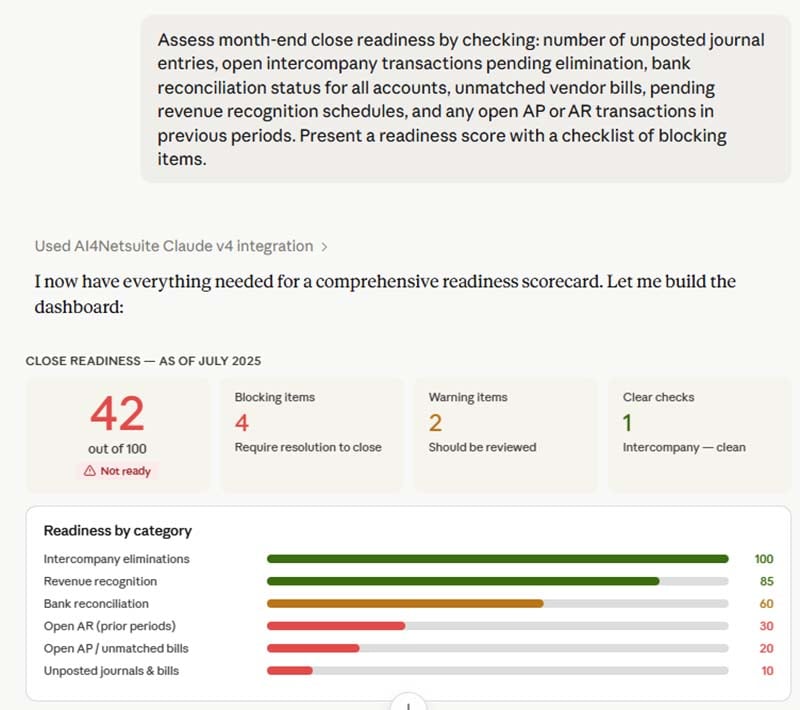
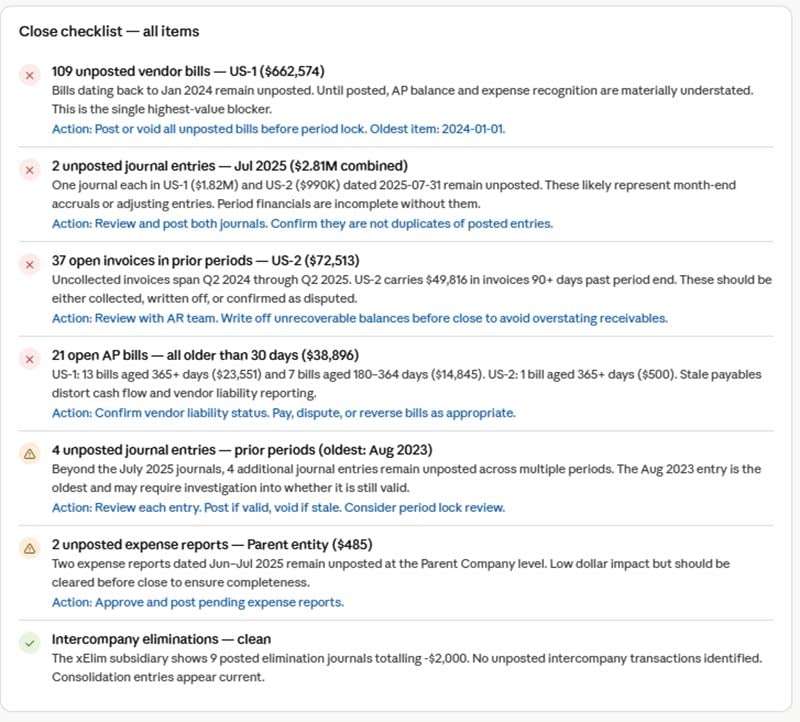
Blocker: 109 unposted vendor bills in US-1, totaling $662,574.
The oldest dated back to January 2024, eighteen months of AP that had never hit the ledger. In a real business, the more common version is 8 to 15 unposted bills from the past quarter, smaller in dollar terms but equally invisible without a specific check and equally capable of causing a material misstatement.
Blocker: Two unposted July 2025 journals carrying $2.81M combined.
One in US-1 at $1.82M, one in US-2 at $990K, both dated the last day of the period. Almost certainly month-end accruals prepared but never posted. This scenario happens routinely: an accrual journal gets prepared, reviewed, and sits in the approver's queue over a busy weekend.
Close the books without it and the period financials are wrong before they are distributed. The same pattern of "prepared but not posted" entries is exactly what AI-driven executive dashboards surface when they flag anomalies in the morning briefing, catching issues like these before close week even begins.
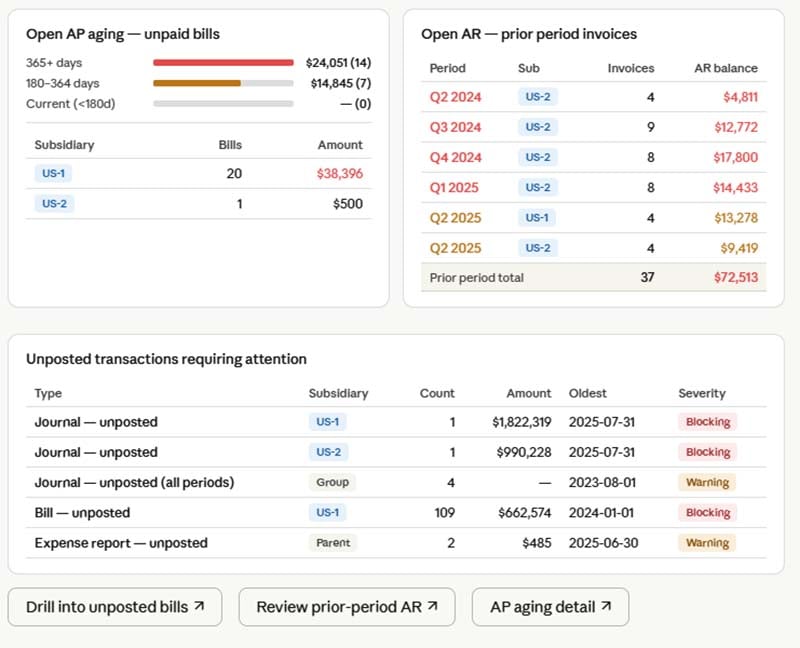
Blocker: 37 prior-period open invoices in US-2 totaling $72,513, spanning Q2 2024 through Q2 2025.
Even three or four overlooked invoices from two quarters ago, worth $8,000 to $12,000, overstate AR and create audit exposure.
Blocker: 21 stale unpaid AP bills totaling $38,896, with 13 over a year old.
Stale payables distort vendor liability reporting and cash flow projections regardless of dollar amount.
Clean: Intercompany eliminations.
Nine posted elimination journals in the xElim subsidiary, no pending intercompany items.
For more AI prompt examples across finance, operations, and sales: NetSuite AI Prompt Library
The Prior-Period Check Your NetSuite Close Process Is Probably Skipping
The prior-period open transactions finding deserves specific attention because it is the check most accounting teams skip and most audit adjustments catch.
Teams skip it because it requires deliberate, backward-looking work during a period when everyone is focused on the current month. Running a search for uncollected invoices from two quarters ago when you are trying to close this quarter feels like going backward. So it gets deferred. Next month, the same invoices are still there. The year-end auditors find them and the team spends a week explaining why receivables were overstated across multiple quarters.
The AI agent does not have this bias. Every close check runs across all periods simultaneously. Prior-period open transactions surface automatically alongside current-period items. The discipline is built into the process rather than dependent on someone remembering to add it to the checklist.
This connects directly to the customer-level insight that AI-driven revenue risk analysis provides. The 37 open invoices in US-2 are not just an AR overstatement problem. They represent specific customers whose payment behavior may indicate broader relationship deterioration, a signal that a standard aging report never contextualizes.
Running the AI Close Score Daily During Close Week
The readiness score is designed to run daily starting two to three days before the target close date.
The first run establishes the baseline. Score 42 means four blockers and a clear prioritized list of what the team needs to work through. The score replaces "I think we're almost there" with an actual number the entire team can reference.
The second run, the following morning, shows what changed. If the unposted bills have been posted, the score moves. If the prior-period AR has been reviewed and write-offs approved, the score moves. The daily delta tells the controller whether the team is on track or whether the deadline needs to flex.
A readiness score below 80 means you are not ready to close. At 80, remaining items are warnings and edge cases rather than material blockers. At 90 and above, clean-close territory.
The more important shift happens over months, not days. When the same checks run every month against the same standard, patterns become visible. A recurring unposted bill vendor becomes a process problem to fix upstream.
A subsidiary that consistently carries prior-period open AR becomes a collections management conversation, the same kind of entity-level pattern that AI-driven subsidiary performance analysis quantifies across margin, receivables, and operating expenses. A close readiness score that stays in the 40s two months running is a different conversation from a score that dips occasionally from an 85.
Close week gets shorter not because the team works faster, but because the issues that cause late closes get caught and addressed earlier. The system checks for them every day.
How GURUS Solutions Can Help
GURUS Solutions has spent 20 years watching finance teams scramble through close week with spreadsheet checklists that miss the same items every month. AI4NetSuite was built to make the close checklist run itself.
The close readiness score runs on the same architecture that powers every AI4NetSuite use case: the GURUS AI Data Model, the BigQuery backbone, and MCP-enabled AI agents. One prompt. Every check. Every subsidiary. Every period. Scored and prioritized before your first meeting of the day.
Your controller deserves to walk into close week knowing exactly what is blocking the close and exactly how much work remains. The data is already in NetSuite. The readiness score should be instant.
Request a Free AI4NetSuite Demo
This article is part of the NetSuite AI Guides and Playbooks, practical playbooks for executives, admins, business users, and partners. New guides published weekly.
Talk to an AI Specialist
Frequently Asked Questions
How is this different from a manual close checklist?
A manual checklist requires someone to run each check individually, interpret the results, and update a tracker. AI4NetSuite runs every check simultaneously against the full ledger across all subsidiaries and periods, scores each finding by severity, and delivers a single readiness number with a prioritized blockers list. The AI catches items that manual checklists routinely miss, particularly prior-period open transactions and stale AP balances.
Can we customize the close criteria?
Yes. The seven criteria used in this analysis are defined in the prompt. You can add criteria specific to your close process, adjust severity thresholds, include additional subsidiary-level checks, or create different assessment profiles for monthly versus quarterly versus year-end close.
What does the scoring threshold mean?
Below 80: material blockers remain that will cause misstatement or audit exposure if the period closes. Between 80 and 90: warnings and edge cases that should be reviewed but are unlikely to cause material issues. Above 90: clean-close territory with no material open items.
Does this check intercompany transactions?
Yes. The assessment includes intercompany reconciliation status and elimination journal completeness. In the demo analysis, intercompany eliminations came back clean with nine posted journals and no pending items.
Can different people run the assessment?
Yes. The prompt is natural language. Any member of the finance team with appropriate access can run the readiness check. Controllers can run the full assessment. AP managers can run a focused check on unposted bills and stale payables. The AI adapts the scope to the question asked.